

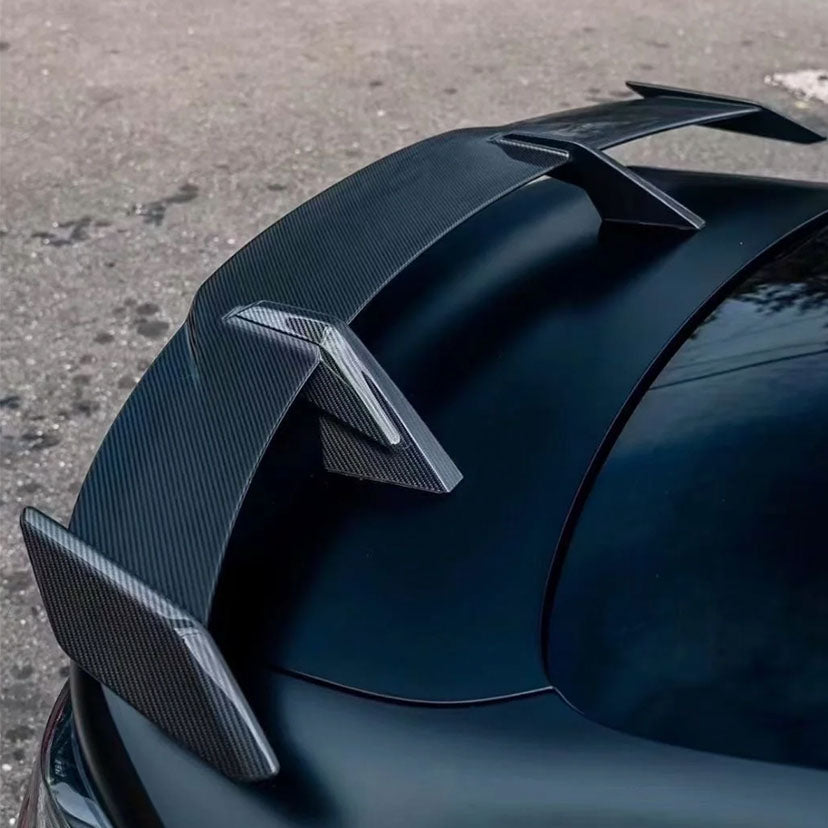

Wind tunnel testing plays a critical role in improving spoiler efficiency. It allows you to analyze how air flows over a vehicle, helping engineers make informed design decisions. By reducing drag and increasing downforce, this method directly enhances vehicle performance. Unlike virtual simulations, wind tunnel testing provides real-world feedback, making it more accurate for refining designs. Wind Tunnel Tested Spoilers ensure better stability and efficiency, especially in high-performance vehicles. Although this process can be costly, its ability to optimize aerodynamics makes it indispensable for achieving maximum performance.
Key Takeaways
-
Wind tunnel tests help cars perform better by studying airflow. They reduce air resistance and increase downward force on spoilers.
-
Engineers use wind tunnels to collect real data. This helps them adjust spoiler designs for better balance and efficiency.
-
Spoilers tested in wind tunnels lower air resistance. This improves gas mileage and car performance, helping buyers and makers.
-
Testing spoilers in wind tunnels improves grip and control. This makes driving fast safer.
-
Using wind tunnels with tools like CFD speeds up design changes. It also makes airflow predictions more accurate.
Understanding Wind Tunnel Testing
What Are Wind Tunnels?
Definition and purpose in automotive testing
Wind tunnels are specialized facilities designed to study how air flows around objects, such as vehicles. In automotive testing, they help you understand how a car interacts with air at different speeds. By using wind tunnel testing, engineers can refine designs to improve fuel efficiency, reduce emissions, and enhance stability. These facilities are essential for optimizing a vehicle’s aerodynamics, ensuring it performs efficiently and safely on the road.
How wind tunnels simulate real-world airflow
Wind tunnels replicate real-world airflow conditions by creating a controlled stream of air that moves over a stationary vehicle. This is achieved using components like fans, turning vanes, and nozzles. The test section, where the vehicle or its parts (like spoilers) are placed, is the central area of the wind tunnel. Airflow straighteners ensure the air moves smoothly, while sensors collect data on how the air interacts with the vehicle. Closed wind tunnels provide precise airflow control, making them ideal for detailed testing, while open tunnels are more cost-effective but less accurate.
The Role of Aerodynamics in Spoiler Performance
Importance of airflow analysis
Airflow analysis is crucial for understanding how spoilers affect a vehicle’s performance. Spoilers are designed to manage the air moving over and around the car, reducing drag and increasing downforce. By analyzing airflow, you can identify areas where the spoiler can be adjusted to improve efficiency. This process ensures the vehicle remains stable, especially at high speeds.
Measuring drag, downforce, and lift
During wind tunnel testing, engineers measure key aerodynamic forces like drag, downforce, and lift. Drag refers to the resistance a vehicle faces as it moves through the air. Downforce pushes the car toward the ground, improving traction and stability. Lift, on the other hand, can reduce stability if not controlled. Engineers use tools like force measurement systems and flow visualization techniques to gather data on these forces. This information helps optimize spoiler designs for better performance.
How Wind Tunnel Testing Works for Spoilers
The Testing Process
Mounting and positioning spoilers in the wind tunnel
To begin wind tunnel testing, you must securely mount the spoiler onto the vehicle or a test rig. The positioning of the spoiler plays a crucial role in obtaining accurate results. Engineers often adjust the angle and height of the spoiler to simulate various driving conditions. This setup ensures that the airflow interacts with the spoiler as it would in real-world scenarios. Proper alignment helps you gather reliable data on how the spoiler affects the vehicle’s performance.
Using sensors to collect aerodynamic data
During testing, sensors capture detailed information about the forces acting on the spoiler. These sensors measure how the air moves around the spoiler and the vehicle. Commonly used sensors include:
-
Multi-axis sensors, which provide a comprehensive view of aerodynamic forces across multiple directions.
-
Strain gauge load cells, known for their accuracy and reliability in measuring forces during wind tunnel testing.
This data helps you understand how the spoiler influences drag and downforce, enabling precise adjustments to improve efficiency.
Key Metrics for Wind Tunnel Tested Spoilers
Drag coefficient and its impact on efficiency
The drag coefficient is a key metric in wind tunnel testing. It measures how much air resistance the vehicle faces. A lower drag coefficient means the car moves more efficiently through the air, improving fuel economy and performance. Wind tunnel tested spoilers are designed to minimize this resistance, ensuring the vehicle operates at peak efficiency.
Downforce optimization for stability
Downforce is another critical factor. It pushes the vehicle downward, increasing traction and stability, especially at high speeds. Wind tunnel tested spoilers are fine-tuned to maximize downforce without creating excessive drag. This balance ensures the car remains stable in various driving conditions, from sharp turns to straight-line acceleration.
Iterative Design Improvements
Adjusting spoiler designs based on test results
Wind tunnel testing allows you to refine spoiler designs through an iterative process. After analyzing the data, engineers make adjustments to the spoiler’s shape, angle, or size. These changes aim to enhance its aerodynamic performance. Each modification undergoes further testing to confirm its effectiveness.
Real-time feedback for enhanced performance
Modern wind tunnels provide real-time feedback during tests. This feature lets you observe how changes to the spoiler impact drag and downforce immediately. By using this feedback, engineers can quickly identify the most effective design improvements. This process ensures that wind tunnel tested spoilers achieve optimal performance and efficiency.
Benefits of Wind Tunnel Testing for Spoilers
Drag Reduction
How spoilers minimize air resistance
Spoilers play a vital role in reducing air resistance, allowing vehicles to move more efficiently. By disrupting and redirecting airflow, spoilers minimize turbulence behind the car. This reduces drag, which is the force that slows a vehicle down as it moves through the air. Wind tunnel testing helps you fine-tune spoiler designs to achieve the lowest possible drag coefficient. This process ensures that the vehicle consumes less fuel and performs better, especially at high speeds.
Examples of drag reduction in high-performance vehicles
High-performance vehicles like sports cars and race cars rely heavily on spoilers to reduce drag. For instance, Formula 1 cars use advanced spoiler designs tested in wind tunnels to achieve maximum speed and efficiency. These spoilers are engineered to cut through the air with minimal resistance, giving the car a competitive edge. Similarly, luxury sports cars like the Porsche 911 utilize wind tunnel-tested spoilers to balance sleek design with aerodynamic efficiency.
Downforce Optimization
Enhancing vehicle stability through downforce
Downforce is essential for keeping your vehicle stable, especially during high-speed maneuvers. It increases the car’s grip on the road by pressing it downward. This added traction allows for better handling and reduces the risk of losing control. Features like rear wings and front splitters work together to enhance downforce. Wind tunnel testing ensures these components are optimized for stability and safety.
-
Downforce improves grip, making high-speed cornering safer.
-
It reduces the chance of losing traction, even on sharp turns.
-
Aerodynamic elements like spoilers and splitters enhance overall handling.
Balancing downforce for different driving conditions
Different driving conditions require varying levels of downforce. For example, a race car needs maximum downforce for sharp turns, while a highway vehicle benefits from a balance between downforce and drag reduction. Wind tunnel testing allows you to adjust spoiler angles and shapes to suit specific conditions. This ensures your vehicle performs optimally, whether on a racetrack or a city street.
Design Refinement
Fine-tuning spoiler shapes for maximum efficiency
Refining spoiler designs involves more than just aesthetics. You need to consider how the spoiler integrates with the vehicle’s body to manage airflow effectively. Wind tunnel testing helps you evaluate and improve key aspects like angle, curvature, and shape. This process reduces lift and drag while enhancing downforce. Thorough testing ensures the spoiler not only looks good but also performs efficiently.
-
Integration with the trunk lid or rear window improves both appearance and aerodynamics.
-
Adjustments to the spoiler’s shape and angle optimize airflow management.
-
Wind tunnel tests and simulations provide valuable insights for refinement.
Case studies of wind tunnel tested spoilers
Many successful spoiler designs owe their efficiency to wind tunnel testing. For instance, the rear spoiler on the Bugatti Chiron underwent extensive testing to balance drag reduction and downforce. This design allows the car to remain stable at speeds exceeding 200 mph. Similarly, the Tesla Model S uses a retractable spoiler tested in wind tunnels to improve aerodynamics without compromising its sleek design. These examples highlight how wind tunnel testing leads to innovative and effective spoiler solutions.
Advanced Methods in Aerodynamic Testing
Computational Fluid Dynamics (CFD)
How CFD complements wind tunnel testing
Computational Fluid Dynamics (CFD) has revolutionized aerodynamic testing by offering detailed simulations of airflow. Unlike traditional wind tunnels, CFD allows you to analyze designs without building physical prototypes. This method is faster and more cost-effective, making it ideal for early-stage testing. While wind tunnels simulate real-world conditions, CFD provides flexibility for exploring multiple design variations. Together, these methods create a powerful combination for refining spoiler designs.
-
CFD delivers precise computational flow modeling, reducing the need for costly physical tests.
-
It enables you to test various spoiler shapes and angles quickly.
-
Wind tunnels validate CFD results, ensuring real-world accuracy.
By combining CFD with wind tunnel testing, you can achieve a balance between virtual and physical testing. This approach enhances the overall efficiency of aerodynamic development.
Advantages of combining virtual and physical testing
Using CFD alongside wind tunnel testing offers several advantages. You can conduct extensive data analysis and make design adjustments before physical testing begins. This reduces the number of prototypes needed, saving time and resources. Additionally, CFD allows you to simulate extreme conditions that may be difficult to replicate in a wind tunnel. This dual approach ensures your spoiler achieves optimal performance in both virtual and real-world scenarios.
Emerging Technologies in Wind Tunnel Testing
Virtual wind tunnels and their applications
Virtual wind tunnels represent a significant advancement in aerodynamic testing. These digital tools use advanced CFD software to simulate airflow around vehicles. You can create and test digital models using CAD/CAE programs, eliminating the need for physical prototypes. This technology speeds up the design process and reduces costs. Virtual wind tunnels also extend beyond automotive testing. For example, they are used in urban planning to analyze wind patterns in city districts. Their versatility makes them a valuable tool for various industries.
-
Digital wind tunnels enable rapid testing of multiple designs.
-
They support applications like pedestrian wind comfort analysis.
-
The shift to virtual testing reflects the industry’s demand for faster, cost-effective solutions.
Innovations improving aerodynamic testing accuracy
Emerging technologies continue to enhance the accuracy of wind tunnel testing. By integrating CFD with traditional methods, you can make faster and more precise design adjustments. Digital wind tunnels allow you to test airflow simulations without physical prototypes, improving efficiency. These innovations ensure that spoiler designs are optimized for real-world conditions while minimizing development costs.
Wind tunnel testing plays a vital role in creating high-performance spoilers. It helps you reduce drag, increase downforce, and refine designs for better efficiency. Advanced methods like CFD and virtual wind tunnels enhance precision by enabling rapid design iterations and accurate aerodynamic predictions. These tools allow you to analyze multiple designs simultaneously, saving time and costs.
Investing in wind tunnel testing also improves fuel efficiency by reducing drag, which can lower fuel consumption by up to 5%. This not only benefits you as a consumer but also boosts manufacturers’ competitiveness. By prioritizing aerodynamic testing, you ensure vehicles achieve optimal performance, safety, and stability.


Share:
Discover the Lightest M4 CSL Parts Today
Step-by-Step Guide to Microwave Curing for Epoxy and Composites