
Why Do Some Carbon Fiber Parts Experience Peeling or Clear Coat Failure? An Industry Perspective
Objective notes on coating choices, production trade-offs, and long-term durability.
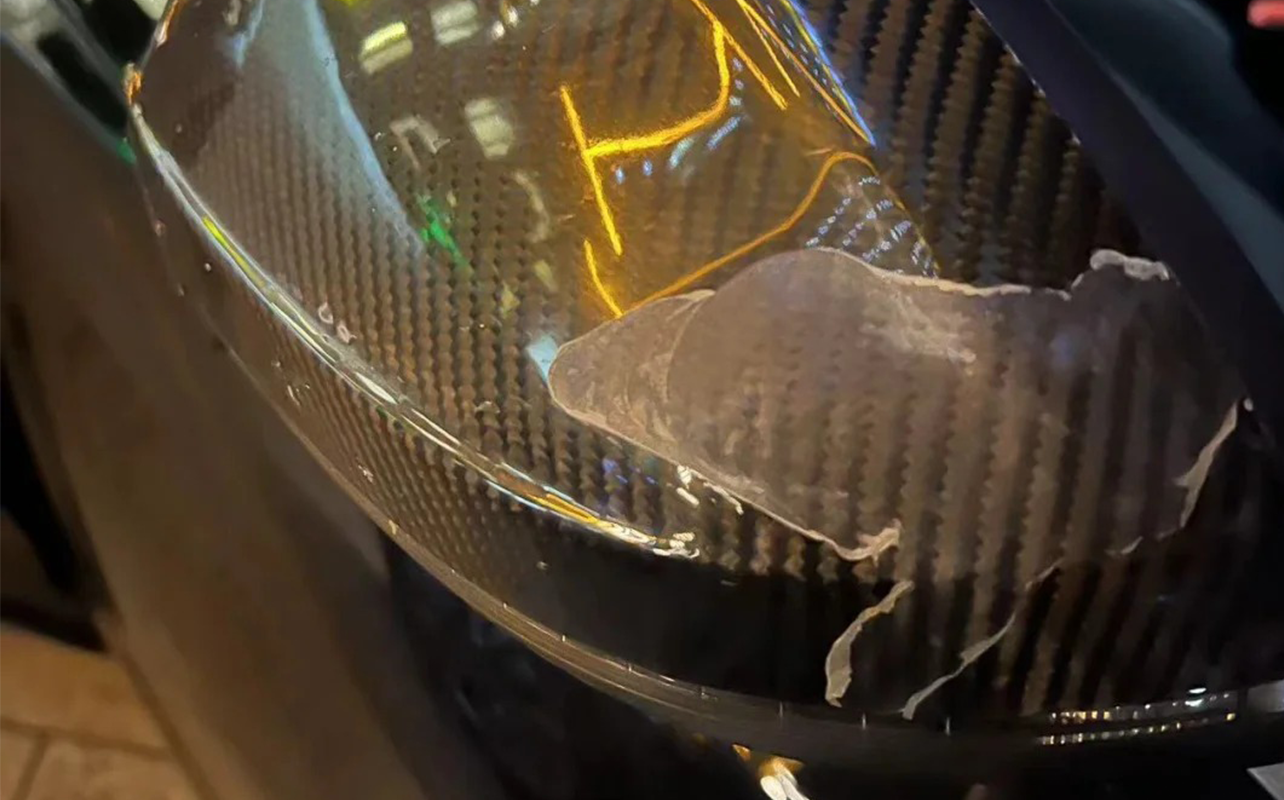
In the automotive aftermarket, it’s common to see carbon fiber parts that look flawless at installation but later develop peeling, cracking, or whole-sheet delamination of the clear coat. In most cases, this is not a problem with the carbon fiber substrate itself. The root cause is usually the choice of finishing process and how well it suits outdoor, long-term use.
The Role of UV-Cured Clear Coats
A large share of carbon fiber parts on the market use UV-cured clear coats.
- Background: The technology emerged from furniture, flooring, and electronics, where rapid curing and high gloss are valued.
- Process: Under ultraviolet light, photo-initiators trigger a reaction that hardens the coating within minutes.
- Advantages: High throughput, lower labor and bake time, and a brilliant “showroom” gloss right off the line.
Limitations of UV-Cured Coatings on Exterior Parts
- Adhesion sensitivity: Carbon fiber surfaces have low surface energy; if surface prep is imperfect, bonding can be weak.
- Weathering durability: Extended sunlight, rain, and thermal cycling can lead to micro-cracking, loss of gloss, and eventual peeling.
- Repairability: Localized repairs are difficult; failures often require stripping and refinishing the entire part.
These factors explain the common “sheet-peeling” effect—large sections of the clear coat lifting away from the part.
Why Many Producers Still Choose UV Coatings
- Production speed: Parts can move from spray to packaging in minutes, enabling fast turnover.
- Overall cost control: While UV materials aren’t necessarily cheap, they reduce labor and oven time.
- Point-of-sale appeal: The ultra-glossy finish looks premium when new, which resonates with buyers unfamiliar with coating chemistry.
In short, UV coatings are best described as optimized for speed and appearance, not for long-term outdoor durability.
The Alternative: 2K (Two-Component) Clear Coats
2K clear coats—widely used in OEM repair and higher-end refinishing—require mixing resin and hardener before application. They cure through a chemical reaction rather than light exposure.
- Stronger bonding: Better adhesion to properly prepared substrates.
- Weather resistance: UV stabilizers and crosslinked films offer improved resistance to sunlight and aging.
- Serviceability: Can be sanded and polished; localized repairs are feasible.
- Trade-off: Higher skill and tighter environmental control are needed; curing takes hours rather than minutes.
Bottom Line
- UV-cured coatings: Fast, glossy, efficient—yet generally less durable outdoors.
- 2K clear coats: Slower and more demanding—yet better suited for long-term exterior use.
Clear coat failures on carbon fiber parts are typically a function of finishing method and process control, not the carbon fiber itself. Understanding these trade-offs helps buyers choose parts that align with their expectations for longevity and maintenance.
Share:
Saying Goodbye to Carbon Fiber? BMW Experiments With Flax-Based Composites