

Alcantara® and Dinamica® look nearly identical in product photos. They appear interchangeably in aftermarket listings, often grouped together under the umbrella term "microfiber suede." But the two are distinct products from different manufacturers with different OEM relationships, and the third option that shows up under the same umbrella, non-branded supplier-grade microfiber suede, may or may not belong to the same material family.
If you are configuring an Audi RS bucket seat or a conversion kit, the Upholstery Material variant is one of the harder calls. The product photos look similar across listings. The category labels read similar. But the source, the manufacturing process, and the OEM use case behind each one differ in ways that affect both visual cohesion against your factory interior and how the upholstery ages over five to ten years.
This guide explains what each material actually is, where it comes from, which Audi (and parallel-brand) factory installations use which, and how the material categories map onto the variant tiers you will see when configuring on our product pages.
What microfiber suede is
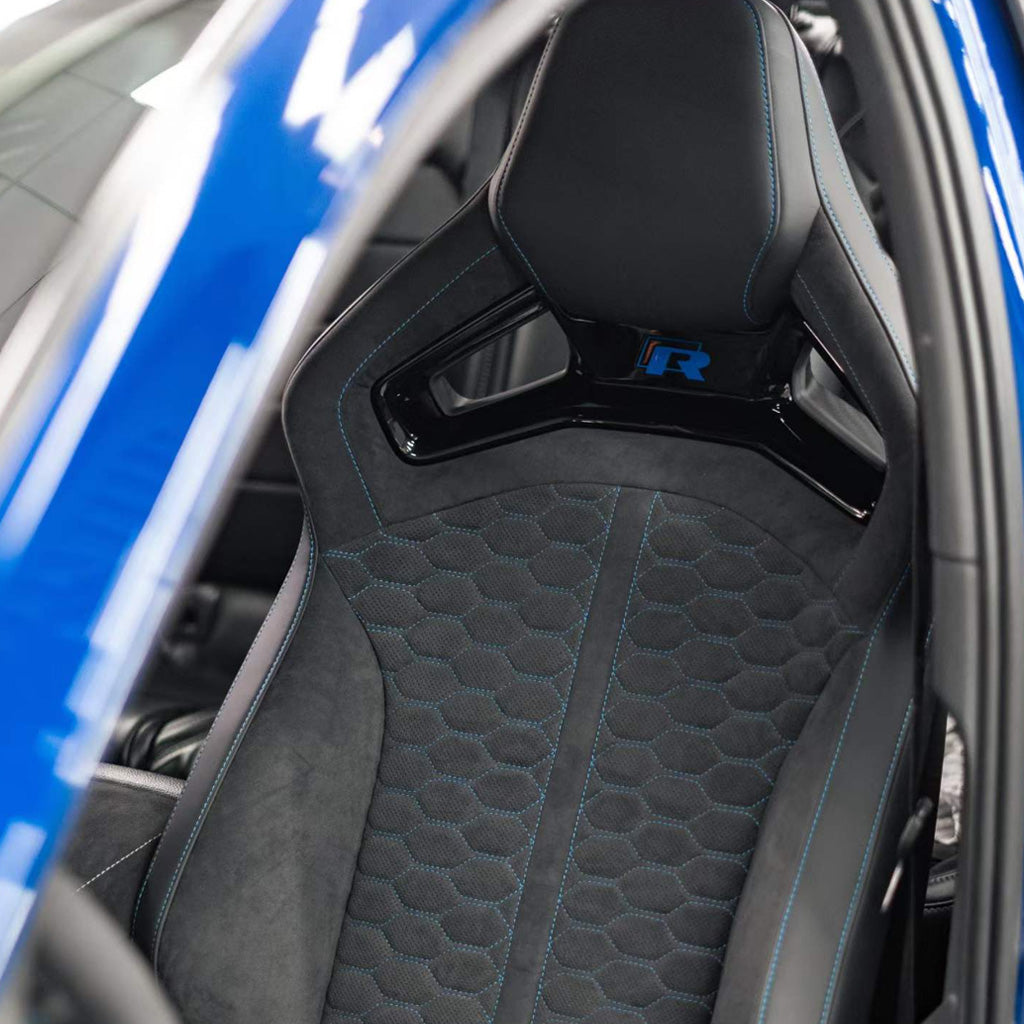
Microfiber suede is a non-woven synthetic textile engineered for automotive and luxury interior use. The construction is a composite of two polymers, typically around 50 percent polyurethane (PU) and 50 percent polyamide (nylon). Manufacturing involves extruding ultra-fine fibers, bonding them through heat and pressure, then mechanically raising the surface to produce the soft suede nap.
The result mimics natural split-grain suede, with real advantages over the animal-source version. Dimensional stability through temperature swings is better. Grain direction stays consistent. There is no batch variability from hide differences. UV resistance is significantly higher.
In the broader synthetic interior fabric market, microfiber suede sits in the upper-mid tier. Below it: PVC-based imitation suedes (low-end, plasticky feel) and PU-coated polyester suedes (middle tier, common in budget aftermarket products). Above it: only natural suede and full-grain leather.
Alcantara® and Dinamica® are both commercial brand names within this microfiber suede category. So is Porsche's Race-Tex®. So are several OEM-spec microfiber materials supplied to BMW, Audi, and Tesla. The material category is consistent across all of them. What changes between brands is the specific supplier, the exact composition ratio, the finishing process, and the certification stack behind each one.
Alcantara® (the Italian original)
Alcantara® is the oldest commercial microfiber suede on the automotive market. The material was developed in the early 1970s by Miyoshi Okamoto, a scientist working for Toray Industries of Japan. Production is based in Nera Montoro, Italy, near Terni. The trademark "Alcantara®" is owned by Alcantara S.p.A., which has been jointly owned by Toray and Mitsui since 1995.
Composition: roughly 68 percent polyester and 32 percent polyurethane.
Alcantara® appears across the Audi RS lineup, the BMW M division, and select Porsche, Lamborghini, and Ferrari models. On the Audi side specifically: RS3, RS4, RS5, RS Q3, and as part of dual-material upholstery on multiple RS6 and RS7 configurations.
The brand carries automotive flame-retardance ratings, a perforation specification that supports ventilation airflow, and decades of OEM relationships behind the certification. It is the reference material that aftermarket microfiber suede products are typically compared against.
In production-tier batches, Alcantara® tends to arrive with a slightly cooler hue. There is a subtle blue undertone present in most batches, not visible on its own, but consistently visible when a swatch is compared against a warmer-toned reference material.
Dinamica® (and why RS6 GT owners need to understand this one)
Dinamica® is produced by MIKO S.r.l., based in Gorizia, Italy. Despite the Italian production base, Dinamica® came into widespread automotive use through partnerships with German automakers. It is now particularly associated with several Audi performance models. Most notably, it is the factory material on the RS6 GT.
Composition: a microfiber composite using recycled polyester fibers, supported by a documented sustainability narrative. MIKO publicly states that each Dinamica® production batch incorporates recycled materials sourced from post-consumer PET bottles.
The practical detail for RS owners:
Alcantara® and Dinamica® are not visually interchangeable. They sit in the same material category and both are well-engineered, but when a Dinamica® sample is placed next to an Alcantara® sample in a 1:1 comparison, the difference shows up reliably. Alcantara® batches lean cooler, with that subtle blue undertone. Dinamica® batches lean warmer and more neutral. Experienced upholsterers can identify each one in a swatch comparison without checking the label.
This matters specifically for RS6 GT owners. The factory interior on the RS6 GT is Dinamica® throughout: door panels, center console wrap, headliner. If the seats are upholstered in Alcantara® instead, the materials do not visually clash in a hard sense. But under direct interior lighting, the color tone gap is persistent and noticeable. The eye registers it as "off" even before identifying why.
This color gap has been verified through direct A/B sample comparison against factory Audi reference materials. For OEM-matching builds on RS6 GT, RSQ3 Edition 10 Years, and RS3 Performance Edition, choosing the wrong material brand creates a low-grade inconsistency that does not resolve over time.
Non-branded supplier-grade microfiber suede
When a listing labels the material as "microfiber suede" without a brand qualifier, the material typically comes from one of several mid-tier microfiber composite suppliers. The composition is in the same range (50 PU / 50 polyamide territory). The manufacturing process follows the same playbook. What it does not carry is the brand certification of Alcantara® or Dinamica®.
The same supplier tier also feeds:
- Porsche Race-Tex® (Porsche's trademarked microfiber suede used across the 718, 911 GT3, Taycan, and multiple Sport seat configurations)
- Tesla's vegan interior trims across multiple model lines
- BMW Sensatec Microfiber on certain non-Individual trims
- Audi's own vegan-configuration trim on entry-level and mid-trim Audi models
The functional gap between certified brand-name microfiber suede and non-branded supplier-grade comes down to trademark licensing, batch consistency guarantees, and accompanying certifications (flame retardance, abrasion resistance, colorfastness). For real-world use on a privately-driven RS, the touch and visual outcome land within tolerances most owners cannot reliably distinguish in a blind test.
The price differential, however, is significant. Certified Alcantara® at the supplier tier runs roughly 3 to 5 times the cost of non-branded microfiber suede with comparable specifications. That cost gap is what shapes the price ladder across our product line.
Cross-OEM material reference
For Audi RS owners matching against a factory installation, this is the practical reference.
| Vehicle | Factory Material | Notes |
|---|---|---|
| Audi RS3 (8Y) | Alcantara® | Standard performance trim |
| Audi RS4 / RS5 (B9) | Alcantara® | Steering wheel, headliner, seat center panels |
| Audi RS Q3 Edition 10 Years | Alcantara® on door inserts, full-grain Nappa leather on seat centers | Layout is leather-forward, suede-secondary |
| Audi RS6 / RS7 (C8) | Alcantara® or Dinamica® depending on trim | RS6 GT predominantly uses Dinamica® across the door panels, center console wrap, and headliner (approximately 37 to 45 percent of interior surface coverage) |
| BMW M3 / M4 / M5 (current) | Alcantara® steering wheel; available Merino leather + Alcantara® seat configurations | Individual trim available |
| Porsche 911 GT3 / GT3 RS | Race-Tex® | Porsche's own branded microfiber suede |
| Porsche Taycan | Race-Tex® on Sport seats trim | Vegan-configurable |
| Tesla Model S Plaid | Tesla vegan microfiber | Non-branded supplier-grade |
The pattern across the table: most premium European OEMs select a microfiber suede tier that matches their brand positioning. Audi's choices split along specific model boundaries. BMW's choices split along trim level. Porsche brought it in-house under its own brand.
For Audi RS aftermarket upholstery, matching the factory material is usually the right call for resale value and interior cohesion. Going with a different category (such as full Nappa leather on a car that came with an Alcantara®-centered trim) is a stylistic choice, not a quality upgrade.
How they perform
Across the three options, here is how they compare on the metrics that matter for daily ownership.
Abrasion resistance, measured by the Martindale rub test. Alcantara® is rated to 50,000+ Martindale cycles. Dinamica® lands between 40,000 and 50,000+ depending on specification. Non-branded supplier-grade microfiber suede varies by supplier and dyeing batch, typically ranging from 20,000 to 40,000 cycles.
UV color stability. All three meet automotive interior standards. Alcantara® and Dinamica® carry brand-specific colorfast certifications. For non-branded microfiber suede, colorfastness depends on the dyeing batch and supplier QA.
Breathability. All three are more breathable than full-grain leather. Perforation patterns work consistently across all three when correctly applied. Mechanical fit and panel cohesion matter more than material brand on the ventilation question.
Long-term hand feel after five to ten years of typical use. Alcantara® and Dinamica® hold their nap consistency longer. Non-branded supplier-grade microfiber suede shows compression earlier in the high-use contact zones (steering wheel grip area, seat bolster lateral contact patches, center cushion compression footprint).
Maintenance. Periodic brushing with a soft suede brush keeps the nap upright. For visible spots, dampen a microfiber-specific cleaner and dab, do not rub. Do not soak. Do not use abrasive cleaners. Cleaning frequency tracks usage intensity rather than material brand.
How these map onto our Audi RS lineup
Across our Audi RS bucket seat and conversion kit product line, four upholstery tiers correspond to specific material categories. Here is where each one sits on the material spectrum covered above.
Premium Microfiber Suede and Microfiber Nappa-Grain Leather (Animal-Free). Non-branded supplier-grade microfiber suede, sourced from the same supplier tier that feeds multiple OEM vegan configurations. Animal-free, color-stable under typical use. This is the entry tier on the Audi RS Bucket Seat Conversion Kit, Audi RS Sport Bucket Seats, and Audi RS Rear Seat Upholstery Cover product pages.
Premium Nappa Leather and Italian Alcantara®. Full-grain Nappa leather on the cushion centers and seat backs, certified Italian Alcantara® microfiber suede on the side bolsters and accent panels. The Alcantara® on this tier is sourced from Alcantara S.p.A. with brand certification.
Full-Grain Merino Leather. Flagship-tier leather equivalent to BMW Individual specifications. For owners prioritizing top-grade leather across the full upholstery surface rather than microfiber accents on bolsters. See the Merino configuration on Audi RS Carbon Bucket Seats.
Audi German OEM-Sourced (Made in Italy). Genuine Audi replacement upholstery, sourced through Audi's authorized parts channel. The material category matches the factory installation for your specific vehicle. For an RS6 GT this means Dinamica® throughout. For an RS3 or an RS4 this means Alcantara®. The correct category is confirmed against your model, year and photos of your current interior before production starts.
If you are cross-shopping our BMW M division builds, the same material classification logic applies across BMW M Carbon Bucket Seats.
How to choose
A practical decision framework based on what owners typically optimize for.
If you want to match your factory interior 1:1. Choose the tier corresponding to what your specific RS came with. For RS6 GT specifically, this means choosing the Audi German OEM-Sourced tier to ensure Dinamica® content. For RS3, RS4, and RS5, the Premium Nappa Leather and Italian Alcantara® tier covers most factory match cases. Send your interior photos in your typical lighting condition, and the right material category will be confirmed before production.
If you want maximum durability and brand certification, with no factory-match constraint. Choose Premium Nappa Leather and Italian Alcantara® or higher. Certified material with Martindale ratings and colorfast guarantees that come with brand-tier QA.
If you want flagship leather appearance. Choose Full-Grain Merino Leather. Leather-dominant interior cohesion across multiple panels, with microfiber reduced or removed from the surface.
If you want genuine Audi factory replacement covers with no compromises. Choose Audi German OEM-Sourced. Dinamica® or Alcantara® content confirmed for your specific car.
If you want vegan or animal-free. Choose Premium Microfiber Suede and Microfiber Nappa-Grain Leather (Animal-Free). Same microfiber category that supplies OEM vegan configurations.
If you are working within a defined budget. Premium Microfiber Suede is the entry tier, and the pricing reflects the material category. It is category-honest pricing, not a compromise on functional quality. Owners on this tier still receive the same construction, the same precision fitment, and the same pre-production review as the higher tiers.
Color matching: the practical detail
Across builds, certain factory color references are harder to match than others. The following gaps are documented across supplier batches.
Copper on RS3 and RS Q3 series stitching. The Audi factory copper reference is FW0195. Standard aftermarket copper threads typically arrive slightly lighter than FW0195, with a brown undertone shift. The factory thread carries a denser sheen and a deeper neutral copper tone. The gap is logged on the color-match reference cards before production.
Berry red on RS6 GT trim. Most aftermarket red threads ship in a tomato red tone. The factory thread is a more saturated berry, leaning slightly purple under direct light. This gap is corrected for through a thread sample shipment cycle before production.
Copper on RS Q3 Edition 10 Years and RS3 Performance Edition. Standard supplier threads run lighter than the FW0195 reference. Compensation is through a two-shade adjustment within the same batch.
Mercato Blue on RS5 specific builds. Stays close to factory across most aftermarket supplier batches. Lower color-match risk.
Standard colors (black, classic red, navy blue) carry the lowest color-match risk across supplier tiers.
For owners who care about exact color match (and at this price point, the level of care is justified), the pre-production process includes a physical thread and material sample shipment step before production starts. The step adds approximately one week to lead time on average. It removes the most common source of post-delivery dissatisfaction on OEM-matching builds.
FAQ
Is non-branded supplier-grade microfiber suede a downgrade from Alcantara®?
It is not a downgrade in material identity. It is the same material category. The differences are in supplier tier, brand certification, and batch consistency guarantees. Functional outcome for most private use cases lands close. Brand certification is what is paid for at the Alcantara® tier, not a different fundamental material.
Will my RS6 GT interior clash if I use Alcantara® instead of Dinamica®?
It will not clash in a hard sense. But there is a persistent low-grade color difference under direct light, because factory Dinamica® runs warmer and Alcantara® runs cooler. This has been verified against factory Audi reference materials. For factory match, choose the Audi German OEM-Sourced tier and Dinamica® content will be sourced to match your car's factory interior.
Can microfiber suede be perforated for seat ventilation?
Yes. All three material categories support clean perforation patterns. Perforation considerations are discussed on each product page and during pre-production review. Heating-only configurations do not require perforation. Ventilation-only or combined H+V configurations do.
How do I maintain microfiber suede over time?
Periodic brushing with a soft suede brush, occasional wet cleaning with a microfiber-specific cleaner. Avoid soaking. Avoid abrasive cleaners. That is the entire maintenance routine.
Is Alcantara® bulletproof against wear?
No material is. Alcantara® and Dinamica® hold up longer than non-branded microfiber suede because of higher Martindale ratings, which translates to slower nap compression in high-contact zones. Over a five-year-plus ownership horizon, the difference becomes visible. Steering wheels show it first. Seat bolsters second.
Why do some aftermarket sellers call non-branded microfiber suede "Alcantara"?
Trademark misuse. "Alcantara®" is a registered trademark of Alcantara S.p.A. Using the name for non-certified material is a brand violation. Reputable suppliers and brands distinguish clearly between certified Alcantara®, certified Dinamica®, and non-branded supplier-grade microfiber suede. If a listing does not make that distinction, asking before committing to an order is reasonable.
Closing
Material selection on an Audi RS build sits at the intersection of long-term interior cohesion and budget. The three material brands (Alcantara®, Dinamica®, and non-branded supplier-grade microfiber suede) along with full-grain leather and OEM-sourced upholstery cover the full configuration space. All are functionally sound. The question is which one fits the specific car, the specific factory interior, and the specific budget.
For owners who want a second look at the material call before configuring, our team confirms the factory category match against your model and year, and reviews color tone match against photos of your existing interior. Contact us before placing your order, and the material category and color match will be confirmed for your specific vehicle.


Share:
BMW G87 M2 Prepreg Carbon Fiber Trunk Lid: Closing Force Explained, Strut Kit vs Counterweight
Microfiber Nappa-Grain Leather vs Premium Nappa Leather vs Full-Grain Merino Leather: A Material Guide for Audi RS Owners