


From S58 to P58: How BMW Turns a Road Engine into a GT3 Racing Weapon
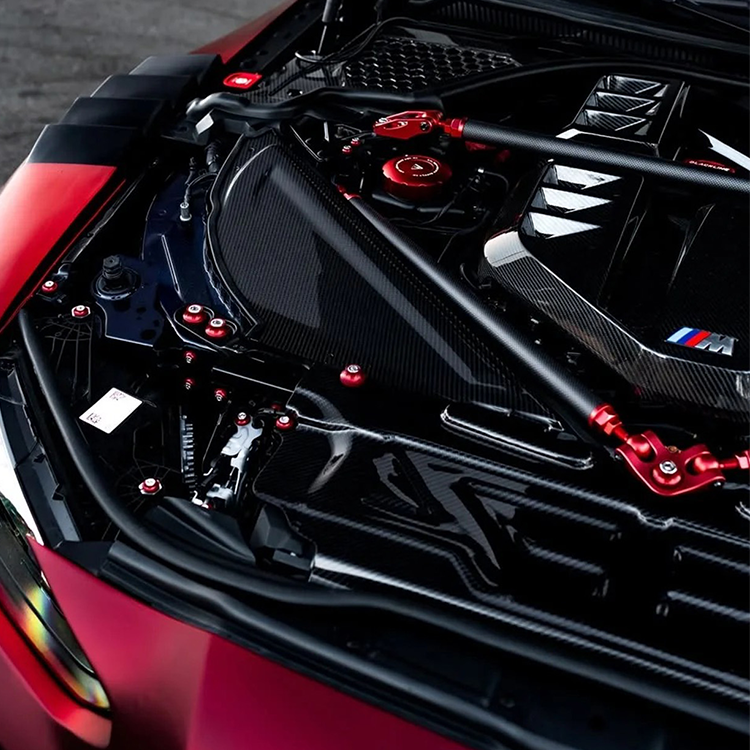
When BMW launched the S58 inline-six, most M-car owners only saw it as “the engine in my G80/G82/G87.” But under the skin, this road-legal powerplant is also the starting point for BMW’s P58 GT3 racing engine. The P58 looks similar on paper – still a 3.0-liter twin-turbo straight-six – yet its priorities, hardware and life cycle are completely different from the S58 you drive on the street.
This article uses the S58 and P58 as a case study to explain how a modern production engine is transformed into a full-blown GT3 racing engine. The goal is not to turn every reader into an engine engineer, but to give M-car enthusiasts a clearer picture of what changes when “street” becomes “race” – and what lessons can be brought back to road-car tuning.

1. S58 vs. P58: Same DNA, Different Missions
On paper, the S58 and P58 share the same basic architecture: 3.0-liter displacement, inline-six layout, aluminum block and head, twin mono-scroll turbochargers and direct injection. But the moment you define their job descriptions, the development directions immediately diverge.
1.1 The S58’s Job: Fast, Civilized and Durable in the Real World
The S58 is designed as a high-output production engine that still has to survive the daily grind:
- Meet global emissions and fuel-economy regulations.
- Deliver smooth drivability in traffic, cold starts and part-throttle use.
- Run for hundreds of thousands of kilometers with reasonable maintenance costs.
- Stay quiet and refined enough for a premium sedan or coupe.
This means the calibration must cover city commuting, long highway drives, poor fuel quality in some markets and owners who may never warm up the engine properly. When you floor it on a highway on-ramp, the control unit is constantly balancing power, emissions, exhaust temperature and long-term durability.
1.2 The P58’s Job: Win Races Within GT3 Rulebooks
In contrast, the P58 exists for one purpose: compete in GT3 racing and survive full-load track abuse under Balance-of-Performance (BoP) rules. The key targets are very different from a road car:
- Deliver repeatable performance over long stints and 24-hour endurance races.
- Operate safely at very high average loads and temperatures.
- Be serviceable at the track, with scheduled rebuilds rather than “lifetime” use.
- Comply with restrictor sizes, boost limits and fuel-flow rules set by GT3 organizers.
If the S58 is a high-performance all-rounder, the P58 is a specialist: it only needs to be happy in a narrow window – flat-out laps on circuit – but in that window it must be absolutely reliable and predictable.
2. Core Hardware Changes: From Showroom Block to Race-Ready Short Block
BMW does not throw away the S58 and design the P58 from scratch. Using a production block as the base keeps costs under control and allows GT3 regulations to recognize it as a derivative of the road engine. But almost every critical component around that base is reconsidered.
2.1 Engine Block, Crankshaft and Bottom End
The production S58 block provides the geometry, bore spacing and basic structure. For racing, the casting may be locally reinforced, and the machining tolerances are tightened. Inside the block, the crankshaft, connecting rods and pistons are usually bespoke racing parts:
- Crankshaft: optimized for higher continuous RPM, with improved oiling to the rod journals.
- Connecting rods: stronger materials and designs (e.g., forged steel or lightweight high-strength alloys) to withstand sustained high cylinder pressures.
- Pistons: race pistons with different crown shapes for combustion efficiency and knock resistance, and coatings to reduce friction and heat transfer.
The goal is not to chase a dramatic peak power number, but to build a bottom end that can live at high load for hours without fatigue failures.
2.2 Valvetrain and Cylinder Head
The P58’s cylinder head still looks related to the S58’s at a glance, but the internals are heavily revised:
- Cams and valve springs: profiles are tailored for the target RPM range and long full-throttle operation. Valve springs are upgraded to resist float when the engine repeatedly hits the rev ceiling on every lap.
- Port shaping: intake and exhaust ports are reworked to improve flow and mixture motion while staying within GT3 regulations.
- Combustion chamber tuning: geometry and surface treatments help control knock and hot spots under sustained boost.
For a road engine, quietness and low emissions at light load are big priorities; for the P58, combustion stability and knock margin at race load matter far more.
2.3 Lubrication and Cooling: The Real Battlefields
If you compare a road car running a few fast laps to a GT3 car doing a 24-hour race, the biggest threats are not “lack of peak power” but oil starvation and heat soak. This is where the P58 diverges most obviously from the S58.
- Dry-sump lubrication: GT3 engines typically adopt multi-stage dry-sump systems with scavenge pumps in the crankcase and head. This prevents oil surge in long, high-G corners and allows the engine to sit lower in the chassis.
- High-capacity oil coolers: race engines run at higher average oil temperatures, so cooler size and airflow are designed specifically for endurance use.
- Dedicated cooling circuits: auxiliary circuits may be added for charge-air coolers, transmission and differential, all tuned as one system with the engine.
For track-day M-car owners, this is also the area where “race logic” can be scaled down for street builds: an upgraded oil cooler, better cooling package and proper oil choice often do more for reliability than chasing an extra 30 hp.
3. Turbocharging, Fuel and Control: Power Under BoP Limits
On the road S58, BMW has to deliver a consistent, warranty-safe power figure on pump fuel, with decent response and acceptable emissions. For the P58, the environment changes: racing gasoline, strict BoP rules and complete freedom to focus on one use case.
3.1 Turbos: From “Broad Band” to “Race Window”
The S58’s twin turbos must work from low RPM in daily driving up to high RPM on autobahns. For GT3, response at low RPM in city traffic no longer matters. Instead, compressor and turbine sizing can be tailored for the rev band where the car spends most of its lap time.
Even when GT3 regulations cap boost pressure or airflow, a more efficient turbo system can improve mid-range torque, transient response out of corners and temperature control – all of which influence stint pace and tire life.
3.2 Fuel System and Injection Strategy
Both S58 and P58 use direct injection, but the P58’s injectors, pumps and calibration are optimized for race fuel and high duty cycles. The engine management can run more aggressive injection timing strategies and reshaped mixture distribution to keep knock under control at high load.
3.3 Engine Management and Data Systems
In a road car, the ECU balances emissions, OBD diagnostics, comfort functions and safety systems. The P58’s control unit is more like a central nervous system for the race car:
- Finer control of boost, torque and traction based on tire wear and fuel load.
- Multiple race maps for different track temperatures, stint lengths or BoP settings.
- Extensive data logging to support post-session analysis and preventative maintenance.
This level of control lets teams trade absolute peak power for consistency, fuel economy in long races and drivability that keeps the car within the driver’s comfort zone for hours.
4. Reliability Philosophy: “Replace on Schedule” vs. “Last the Life of the Car”
One of the biggest misconceptions is that “race engines are fragile.” In reality, they are reliable within a clearly defined life cycle – it is just a different concept of reliability.
4.1 Road-Car Reliability
The S58 is engineered for a long service life with minimal intervention. That includes:
- Extended oil-change intervals for owners who mostly drive in normal conditions.
- Components designed for tens of thousands of hours of mixed-load use.
- Safety margins for poor fuel quality, neglected maintenance and extreme climates.
If you track your S58 regularly without upgrading cooling and lubrication, you are effectively using the engine outside its original “design envelope,” which is why many tuners recommend shorter oil-change intervals and additional hardware.
4.2 Race-Engine Reliability
The P58, however, is built around scheduled overhauls:
- Critical components have defined life in hours or race distance.
- Parts are inspected and replaced based on data and experience, not “run until failure.”
- The whole package is tuned so that, within its planned life, it can be pushed close to its mechanical limits.
In other words, a race engine is not less robust; it is just optimized for a different economic model – regular rebuilds instead of “fit and forget.”

5. What M-Car Enthusiasts Can Learn from S58 → P58
For most CarbonXtreme customers, the P58 will only ever appear on live streams from GT races. But understanding how BMW bridges S58 and P58 actually helps make smarter choices for road-car builds.
5.1 Respect the Cooling and Lubrication Envelope
Before chasing dyno numbers, think like a race engineer:
- Upgrade engine, transmission and differential cooling if you track the car often.
- Use high-quality oil and shorten service intervals under track use.
- Monitor oil temperature and pressure; treat any abnormal readings as a serious warning.
The P58 devotes enormous attention to these systems for a reason – they are the foundation that power sits on.
5.2 Tune for Consistency, Not Just Peak Power
GT3 teams care more about average lap time and tire life than a single hero lap. For a road-car build, that translates to:
- Favor stable, repeatable power over “dyno glory pulls.”
- Choose turbo and mapping packages with proven track data, not just peak numbers.
- Focus on throttle response, heat management and drivability over long sessions.
A slightly lower peak figure that the car can hold for 10 laps is often faster – and kinder to the engine – than a spike you can only see once.
5.3 Think in Systems, Not Single Parts
The P58 is not just a strong short block or big turbo; it is an integrated system designed around a mission. When you modify an S58, try to copy that mindset:
- Match intake, exhaust, cooling and engine management as a package.
- Consider chassis, brakes and aero together with power upgrades.
- Plan your build path: “fast road,” “track day,” or “time-attack style,” and choose parts accordingly.
You do not need a full GT3 program, but a little of that race-engineering logic will keep the car sharper and more reliable.
6. Conclusion: One Platform, Two Worlds
The S58 and P58 show how far a modern engine platform can stretch. One version takes your kids to school, survives traffic jams and passes emissions audits; the other version runs flat-out for hours in a GT3 car, living on the edge of mechanical and thermal limits.
For M-car owners, the key takeaway is not that “race engines are mysterious,” but that engineering is always about clearly defined goals and trade-offs. When you understand what BMW changes – and why – on the journey from S58 to P58, it becomes much easier to plan your own build, choose the right parts and treat your engine the way it was meant to be used.
References and Further Reading
-
References and Further Reading
-
BMW M Motorsport. “BMW M4 GT3: BMW M Motorsport Media Guide.” BMW Group Press, 2021. (Official technical data and development notes for the M4 GT3 and its P58 engine.)
-
BMW M Motorsport. “BMW M4 GT3 EVO.” BMW M Official Motorsport Page, 2024. (Overview of the M4 GT3 EVO, including power figures and technical highlights of the P58.)
-
BMW Group PressClub USA. “BMW M Motorsport presents the new BMW M4 GT3.” Press release, June 2, 2021. (Launch announcement of the M4 GT3 and the 3.0-liter P58 inline-six.)
-
cinch. “BMW S58 engine: Everything you need to know.” Technical overview of the S58 road engine, applications and key specs.
-
BMWBlog. “BMW S58: Reliability, Efficiency and Tuning.” Article discussing S58 performance characteristics, tuning headroom and reliability points for enthusiasts.
-



Share:
The Split or the One-Piece: A Carbon Fiber Dilemma Behind BMW’s Iconic Grille
BMW G87 M2 Prepreg Carbon Fiber Trunk Lid: Closing Force Explained, Strut Kit vs Counterweight